

Important Vastu Checks for New Home
Top 10 Critical Vastu Checks For Home The “Dream Home” or a Structural Trap? The Technical Audit of a Lifetime Buying a property is not
When entering the architectural domain of a temple, monastery, prayer hall, or sacred shrine, spatial geometry shifts from mortal commerce to absolute cosmic manifestation. A temple is not a public social gathering center or a decorative monument; it is a highly advanced psycho-acoustic spiritual reactor. It is an energetic machine explicitly engineered to draw down cosmic wavelengths, concentrate high-vibrational telluric (earth) energies, amplify devotional sound frequencies, and project a pure spiritual vortex that heals, elevates, and transforms the human consciousness.
The devastating, irreversible error made by religious trusts, cultural committees, and traditional architects is treating temple construction purely through the lens of aesthetic stone carving, congregation capacity, and standard parking logistics. If the inner sanctum is built over an energetic void, the primary deity is installed in a draining sector of elimination, or the sacrificial fire altars are placed in a water gate, the entire spiritual portal short-circuits. Instead of radiating peace, protection, and divine energy, the space will feel flat, causing spiritual stagnation, financial management deficits for the trust, recurring administrative disputes, and a visible decline in devotee footfall.
To build a monumental sacred space that maintains its spiritual power for generations and serves as an unshakeable anchor of divine energy, the entire layout must be organized using a highly sophisticated, degree-accurate 16-zone sacred grid calibration.
A sacred temple complex must balance silent spiritual focal points with high-volume crowd movement and heavy structural stone mass under a single geometric footprint.
                      [Sacred Spatial Infrastructure]
                                     │
       ┌─────────────────────────────┼─────────────────────────────┐
       ▼                             ▼                             ▼
[The Cosmic Node]             [The Devotional Loop]         [The Ritual Fire Engine]
 ∙ Garbhagriha (Inner Sanctum) ∙ Mandapa Congregation Halls  ∙ Homa Kunda & Fire Pits
 ∙ Absolute Center Focus       ∙ Pradakshina Walkways        ∙ Main Temple Kitchens
 ∙ Divine Epiphany Conduit     ∙ Kinetic Devotional Flow     ∙ South-East Agni Activation
The core chamber where the main deity or sacred symbol is installed represents the dense space and spirit elements (Akasha). This absolute center point must be calculated with astronomical precision to align perfectly with the intersection of the earth’s magnetic grid lines, creating a powerful conduit for divine manifestation.
The congregation halls and circumambulation (Pradakshina) pathways handle the kinetic movement of thousands of devotees chanting prayers. This zone relies heavily on the air element (Vayu) to carry sound vibrations smoothly through the space, elevating the collective consciousness of the crowd.
The sacred fire altars, oil-lamp storage units, and community kitchens (Mahaprasad zones) represent the active fire element (Agni). This energy must be perfectly balanced to maintain the continuous spiritual heat required to sustain the temple’s energetic purity.
Simply click on the button below, fill the attached details to get a detailed personalised e-horoscope with charts, predictions, and suggestions for absolutely FREE!
The exact mathematical layout, stone selection, and energy-charging protocols for temples are exhaustively documented in the Agama Shastras and classic Vastu manuals. The Mayamatam (Chapter 18, Verse 1) explicitly outlines the cosmic purpose of temple architecture:
“The temple is the literal body of the cosmic being, carved in stone and aligned with the stars. When the measurement of the walls, the height of the spire (Shikhara), and the position of the deity match the true mathematical lines of the grid, the divine essence resides there permanently, bringing absolute protection, rains, and prosperity to the entire kingdom.”
Furthermore, the Brihat Samhita specifies that deities should only be installed in environments where the mind finds immediate peace, proving that spiritual resonance is a direct result of precise spatial geometry.
To ensure your temple or religious center functions as a pure, high-vibration spiritual generator, every primary sacred asset must sit within its mathematically correct zone.
The position of the main idol or central altar dictates the core energetic frequency radiated by the entire religious complex.
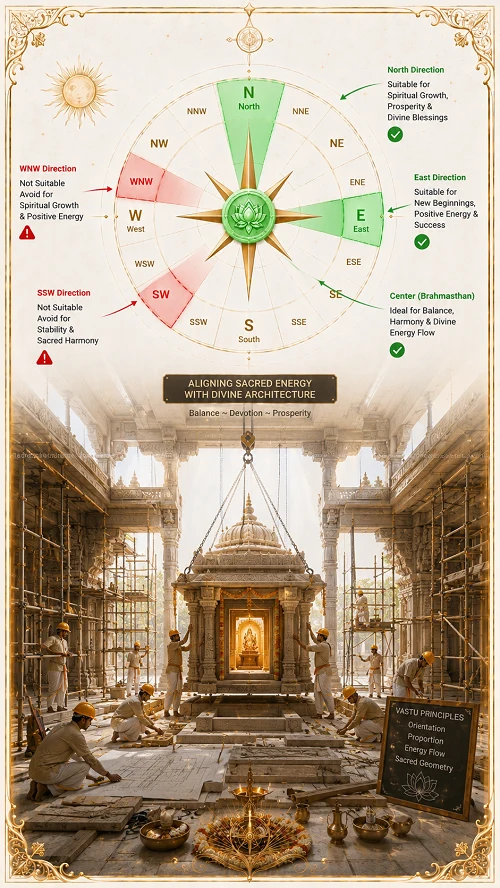
The Optimum Coordinates: The inner sanctum (Garbhagriha) must be positioned in the absolute Center (Brahmasthan) of the property, or aligned precisely along the East (Indra) or North (Mukhya) sectors depending on the specific cosmic aspect of the deity. This positions the deity at the highest source of inbound energy, projecting divine blessings across the entire complex.
The Structural Violations: Placing the main deity installation or altar in the South-South-West (SSW) zone of waste and elimination or the West-North-West (WNW) zone of depression drains the temple’s spiritual energy, making the space feel heavy, cold, and uninspiring to visiting devotees.
The sacred fire altars where offerings are made represent the primary purifying engine of the religious complex.
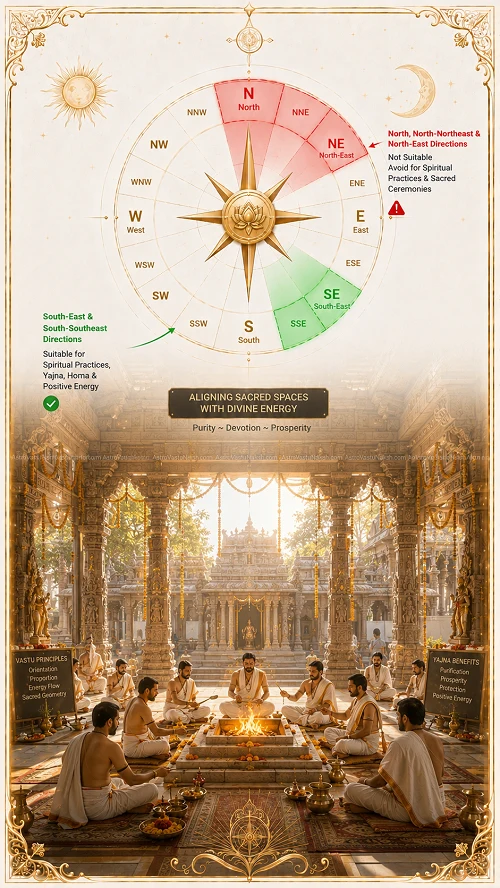
The Optimum Coordinates: The Yajna Shala, Homa Kunda (fire pits), and the storage for clarified butter (Ghee) and oil lamps must sit strictly within the South-East (Agni) zone or the South-South-East (SSE) sector. This keeps the ritual fire element stable, ensuring that the sound and smoke from rituals completely purify the atmosphere.
The Structural Violations: Building a fire altar or main lamp-lighting station in the North-East (Ishan) or North zone creates a major elemental conflict. This can lead to frequent administrative arguments among the temple trustees, sudden accidents during rituals, and ongoing management issues.
The financial storehouse of a temple handles public donations, endowment funds, and valuable ritual ornaments.
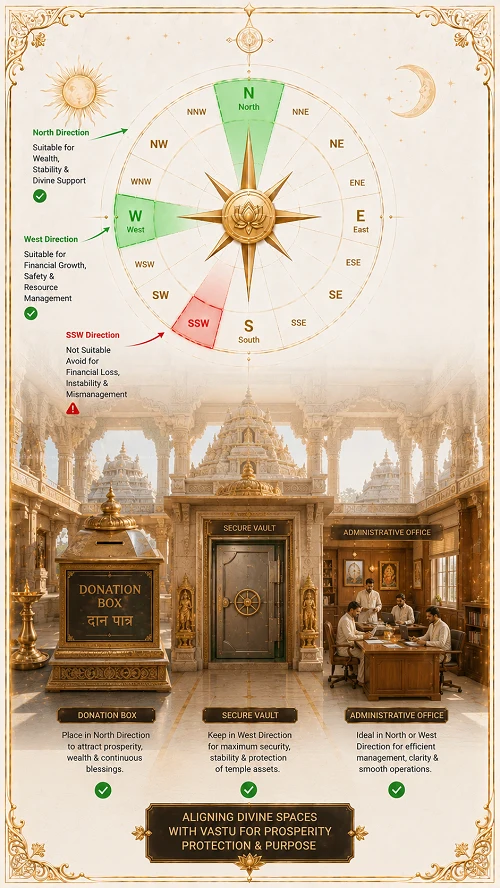
The Optimum Coordinates: The primary donation box (Hundi), secure vaults, and the administrative office of the temple trust should be anchored in the North (Kuber) zone to attract steady funding, or the West (Varuna) zone to secure long-term financial growth and legal stability for the trust.
The Structural Violations: Placing the main donation box or trust accounts desk in the South-South-West (SSW) zone of elimination leads to unexplained financial leaks, mismanagement of public funds, and unexpected operational debts.
| Sacred Asset / Ritual Utility | Ideal 16-Zone Location | Spiritual & Operational Impact |
| Grand Entrance Gate (Gopuram) | North (N) / East (E) | Invites high-vibration cosmic energies, bringing peace and clarity to devotees as they enter. |
| Meditation & Silent Prayer Halls | North-East (Ishan) | Connects the mind directly to pure cosmic awareness, enabling deep spiritual experiences. |
| Holy Water Tank / Temple Well | North-East (NE) / North (N) | Acts as a powerful energy amplifier, infusing the water with healing and purifying traits. |
| Pradakshina (Circumambulation) | Clockwise Outer Perimeter | Follows the natural magnetic lines of the earth, recharging the body’s subtle energy fields. |
| Community Kitchen (Mahaprasad) | South-East (Agni) | Infuses the cooked food with vital life-force energy, turning daily meals into sacred nourishment. |
| Footwear Restrooms & Waste Hubs | South-South-West (SSW) | Keeps impurities and heavy worldly energy completely separated from the sacred zones. |
To preserve the spiritual purity of a sacred complex and elevate the mindset of everyone who visits, the color palette must be carefully chosen across its 16-zone layout. The main entrance gate should be finished in brilliant white, soft gold, or light sandstone yellow to present a clean, high-vibrational welcome to the world. For the inner temple walls and congregation halls, use deep saffron, soft marigold yellow, or light copper tones in the eastern and southern sectors to stimulate devotion, courage, and spiritual focus. Use pure titanium white or soft cream in the northern and northeastern meditation zones to encourage absolute mental silence and spiritual clarity. Avoid dark, dull colors like heavy black, dark charcoal grey, or deep brown anywhere near the main prayer altars, as these tones block light and trap stagnant worldly energies within the sacred space.
In historic temples, ancient stone shrines, and structurally delicate religious centers, breaking down solid rock walls, altering structural pillars, or moving a long-established deity installation is spiritually forbidden and physically impossible. At AstroVastuNaksh, we utilize high-precision No-Demolition Micro-Elemental Engineering to balance your sacred space’s energy while respecting its structural history:
Acoustic Mantra Balancing: We use targeted bell placement, calculated conch-blowing directions, and precise geometric alignments to clear away stagnant energy pockets and keep the environment spiritually charged.
Elemental Metal Inlays: We inlay thin, sacred metal wires (such as pure Gold, Silver, Copper, or Brass) into stone floors around misplaced utilities or restrooms to completely block and isolate negative energy.
Yantra Grid Activation: We install mathematically engraved geometric copper plates (Yantras) and metallic helixes beneath the flooring or high up in the roof trusses to realign skewed magnetic lines, restoring perfect spiritual harmony to the entire site.
..who are transforming their lives with our weekly update, Subscribe to our Newsletter today!
Spiritual organizations are notorious for behind-the-scenes politics. Look at the South West (SW – Stability & Skill) and East of South East (ESE). If the ashram head or managing trustee sits in a weak, cut, or “Disposal” zone, their authority disappears, leading to factionalism, ego clashes, and public scandals that tarnish the institution’s reputation.
Check the North East (NE – Ishanya) and Brahmasthan (Center). The NE governs Spiritual Connection and Mental Clarity. If your main hall sits in the East of South East (ESE – Churning & Anxiety) or has heavy structural load right in the center, seekers won’t drop into deep stillness; they’ll spend the entire session battling overactive thoughts and physical discomfort.
The primary deity or central altar belongs strictly in the North East (NE) or the East, facing East or West. Placing the main deity in a South of South West (SSW) or West of North West (WNW) zone creates a misalignment between the idol’s consecrated energy and the Earth’s natural magnetic flux, making the space feel heavy rather than uplifting.
The collection box or digital donation counter belongs in the West (Gains & Fulfillments) or North (Opportunities & Cash). If your temple’s Hundi or donation desk is placed in the SSW (Disposal) zone, you are energetically discarding incoming offerings. Move the collection hub to the West to ensure financial sustainability for your charitable work.
Check the South of South East (SSE – Power & Confidence) and East (Social Connections & State). If your administrative office or land paperwork is kept in an imbalanced ESE or SSW zone, local authorities will tie your expansion plans in endless red tape, environmental objections, or land dispute litigation.
Sacred mantras and consecrated idols elevate the space, but they operate within physical reality, not outside it. A temple built on a compromised magnetic grid is like putting a high-performance engine in a car with misaligned wheels. Vastu doesn’t replace devotion; it aligns the physical container so the spiritual energy can flow without structural resistance.
Top 10 Critical Vastu Checks For Home The “Dream Home” or a Structural Trap? The Technical Audit of a Lifetime Buying a property is not

7 Horses Painting In Vastu Why Your “Lucky” 7 Horses Painting Might Be Stalling Your Progress In the cluttered world of “Social Media Vastu,” the

Vastu Tips For Toilets In Home Is Your Toilet Flushing Your Wealth and Health Down the Drain? Let’s stop being polite: Your toilet is the

10 Best Vastu Tips For Mandir In Home: Is Your Mandir Radiating Energy or Absorbing It? If you treat your home temple as just another

10 Best Vastu Tips For Kitchen Is Your Kitchen Cooking Your Finances or Your Health? Welcome to the “Agni” pit of your home—the kitchen. While
© All Rights Reserved - www.AstroVastuNaksh.com
All ‘ * ‘ marked fields are mandatory.
Please ensure the form is filled properly, including all mandatory fields.

Please share your details and our team will connect with you regarding your request.