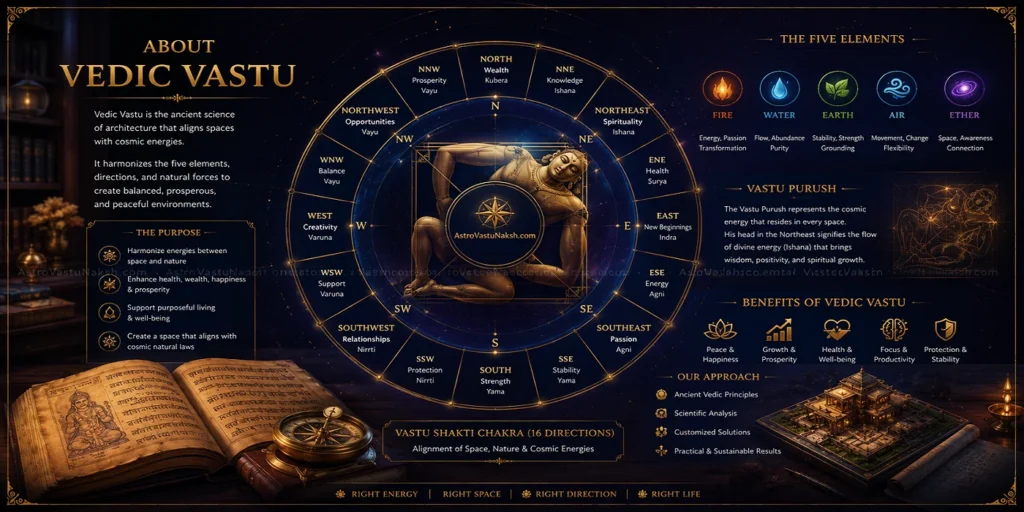
Sthapatya - Origin Of Vastu
Most people treat Vastu like a furniture-moving hobby. Let’s get one thing straight: Vastu Shastra is a sub-Veda (Sthapatya Veda). It is the applied science of the Atharva Veda, designed to synchronize human biology with the Earth’s magnetic field and solar radiation.
As the Vishwakarma Prakash (1.1) states:
“Shastrenena Vidhanena Sarvam Jagat Suhrudayam” (By the laws of this Shastra, the entire universe is held in harmony.)
The ancients didn’t care about your “aesthetic preferences.” They cared about Sthapatya, the science of establishing a firm foundation. Books like the Mayamatam and Manasara weren’t written for interior designers; they were written for master architects who understood that a building is a living organism. If you think Vastu is a “belief system,” you’re mistaken. It’s a set of architectural laws. If you ignore gravity, you fall. If you ignore Vastu, your life’s “structural integrity” collapses.
ORIGIN OF VASTU PURUSH: At AstroVastuNaksh, we view ancient myths not as mere folklore, but as “Encoded Architecture”—a sophisticated data set wrapped in a story to ensure its preservation through the ages. The legend of the Vastu Purusha is our primary blueprint for understanding how a physical space interacts with cosmic biological rhythms.
In the primordial era of Vedic cosmology, the Vastu Purusha emerged from a drop of sweat shed by Lord Shiva during an intense cosmic conflict. He was a being of pure, unbridled energy—massive, chaotic, and possessing a hunger that threatened to consume the very vitality of the Earth. To stabilize this raw force, the deities of the Vedic pantheon acted in unison, pinning him down to the ground.
As the Mayamata recounts, “the gods, numbering forty-five, pressed upon the body of the Purusha, transforming a chaotic force into a stable field of energy” (Chapter 7, Verse 10). This fixed posture created the Vastu Purusha Mandala:
The Head: Positioned in the Northeast, receiving the first light of consciousness.
The Feet: Anchored in the Southwest, providing heavy, grounded stability.
The Navel: Resting at the Center (Brahmasthan), the zero-point where the vacuum of space resides.
By pinning him down, the gods didn’t just stop his hunger; they “calibrated” him. At AstroVastuNaksh, we see this as the transition from a chaotic environment to a structured, habitable “Bio-Resonant” space.
The myth serves as a mnemonic for environmental physics. Each deity pinning a limb represents a specific energy frequency.
| Direction | The Mythological Anchor | The AstroVastuNaksh Logical Application |
| Northeast (Ishanya) | Shiva/Ishana: The Crown/Head | The Portal of Clarity. This is where the Earth’s magnetic flux is highest. Ideal for meditation and water elements, as noted in Vishwakarma Prakash (Ch. 2, V. 31). |
| East (Purva) | Indra: The Solar Eye | The Vitality Source. Maximizes early morning UV rays, which are scientifically proven to synthesize Vitamin D and purify the air. |
| Southeast (Agneya) | Agni: The Digestive Fire | The Metabolic Zone. Ideally suited for kitchens and electrical systems to safely house the element of heat and transformation. |
| South (Dakshina) | Yama: The Restrictor | The Shield. High gravitational pull here requires heavy walls and storage to ground the energy of the household. |
| Southwest (Nairitya) | Nairiti: The Stabilizer | The Control Center. As the feet of the Purusha, this is the most grounded zone. Best for the Master Bedroom to ensure authoritative presence and ancestral strength. |
| West (Paschima) | Varuna: The Fluidity | The Social Filter. Governs the setting sun and the evening’s “churning” energy, making it suitable for dining or study. |
| Northwest (Vayavya) | Vayu: The Wind | The Circulation Hub. Ideal for guest rooms or transit areas, facilitating the movement of people and ideas (Vastu Vidya, Ch. 12, V. 5). |
| North (Uttara) | Kubera: The Treasurer | The Magnetic Vault. Aligned with the magnetic North, it creates a field that favors the accumulation and protection of financial resources. |
Classification Of Vastu
Vedic Vastu Shastra is a vast technical science that goes far beyond simple room placement. It classifies Vastu based on the specific application, the nature of the structure, and the mathematical calculations used to ensure harmony with cosmic energy.
Classification of Vastu: It is broadly classified in 4 systems.
A. Classification by Physical Application
The classification of Vedic Vastu is not merely an architectural guideline but a profound cosmological framework that integrates the physical world with the vibrational frequencies of the universe. In the classical tradition, Vastu is defined as Vasu, the earth, and Vastu, anything that resides upon it. As a science, it extends beyond the four walls of a house to encompass every physical vessel that contains or supports life.
The Mayamata, one of the most revered treatises on the subject, provides the foundational quartet of physical applications, asserting that “Earth, buildings, vehicles, and furniture are the four categories of Vastu” (Mayamata, Chapter 2, Verse 1). This classification recognizes that energy (Prana) interacts with different mediums in unique ways, necessitating distinct mathematical and logical approaches for each.
Bhumi Vastu (Land): The primordial stage of any creation is Bhumi Vastu, the science of the land. It is scientifically logical that the foundation must be compatible with the structure it supports. The Samrangana Sutradhara emphasizes that the “examination of the soil is the first duty of the Sthapati” (Chapter 8, Verse 1), as the geological and magnetic properties of the earth directly influence the biological health of the inhabitant.
Vedic texts classify Bhumi by color, taste, and smell to determine its mineral content and drainage capacity. For instance, the Vishwakarma Prakash suggests that land sloping towards the North and East allows for the accumulation of beneficial solar and magnetic flux (Chapter 1, Verse 38). From a modern perspective, this relates to “slope-hydrology” and the optimization of morning UV radiation, which acts as a natural disinfectant for the site.
Prasada Vastu (Buildings): Prasada Vastu encompasses all built forms, from residential dwellings to monumental temples. The word Prasada itself implies a “seat” or a “palace” where energy is settled. According to the Brihat Samhita, the proportions of a building must follow strict mathematical ratios to prevent structural and energetic decay (Chapter 53, Verse 4).
The scientific logic here lies in the Vastu Purusha Mandala, a grid that serves as a metaphysical blueprint. By dividing the space into 81 (Ekashiti) or 64 (Manduka) padas, the architect aligns the building’s internal grid with the Earth’s cardinal grid. This ensures that the building acts as a resonator, amplifying the positive electromagnetic frequencies of the North-East (Ishanya) and grounding the heavy infrared frequencies of the South-West (Nairutya), as detailed in the Vastu Vidya (Chapter 7, Verse 12).
Yana Vastu (Vehicles): Often overlooked in modern practice, Yana Vastu is the application of Vastu principles to vehicles and modes of transport. The Mayamata dedicates an entire section to the construction of chariots and boats, noting that “a vehicle built with correct proportions ensures a journey without obstacles” (Chapter 31, Verse 1).
In antiquity, this involved the selection of specific woods and the calculation of center-of-gravity to ensure stability. The logic of Yana Vastu is essentially an early form of aerodynamics and fluid dynamics; it acknowledges that a moving object creates its own micro-environment and must be balanced to withstand external forces while maintaining the internal equilibrium of the traveler.
Sayana Vastu (Furniture): The final classification, Sayana Vastu, focuses on the objects of rest and utility, such as beds (Paryanka), seats (Asana), and storage units. The Manasara describes the measurements of a royal bed in exquisite detail, stating that even a minor error in the height of the leg can lead to illness for the sleeper (Chapter 18, Verse 22).
Scientifically, this pertains to the ergonomics of the human body and the interaction between the individual’s personal energy field and the materials they touch for extended periods. Since humans spend approximately one-third of their lives in the “Sayana” state (sleep), the alignment of the bed—specifically avoiding the North-Head orientation to prevent interference with the Earth’s magnetic field—becomes a critical application of this branch.
B. Ayadi Vastu: The Science of Dimensions
At AstroVastuNaksh, we approach the architectural process not merely as a construction of walls, but as the creation of a living, vibrating organism. The pinnacle of this precision is Ayadi Vastu, the mathematical heart of Vedic architecture. Often referred to as the “Astrology of Buildings,” Ayadi is the computational bridge between the celestial frequencies of the owner and the terrestrial dimensions of the structure.
As established in the Mayamata, “the success of a building is rooted in its measurements; without Ayadi, a house remains a lifeless shell” (Chapter 9, Verse 1). By applying these formulas, we ensure that the building’s dimensions resonate at a frequency that promotes health, wealth, and spiritual evolution.
The Ayadi system consists of six primary formulas, collectively known as Shad-Varga. These calculations use the perimeter (Adthisthana) or area of a building to derive its energetic profile:
Aaya (Income/Gain): Aaya represents the inflow of positive energy and material prosperity into the space. The Vishwakarma Prakash instructs that the “Aaya must always exceed the Vyaya (expenditure) to ensure the householder’s growth” (Chapter 2, Verse 72). Scientifically, this formula calculates the “gainful” vibration of a dimension, ensuring the space acts as a net accumulator of Prana.
Vyaya (Expenditure): To maintain financial and emotional stability, the Vyaya calculation is used to minimize outgoing energy. In the Samrangana Sutradhara, it is noted that “a Vyaya greater than Aaya leads to the depletion of resources and mental peace” (Chapter 12, Verse 18). At AstroVastuNaksh, we fine-tune measurements so that the mathematical remainder of this formula is consistently lower than that of the Aaya.
Yoni (Directional Energy): The Yoni is perhaps the most critical technical aspect of Ayadi, as it determines the direction from which the building absorbs its vital force. The Manasara classifies eight Yonis, stating that “the Dhvaja (Eastern) Yoni is the most auspicious for all human dwellings as it aligns with the rising solar energy” (Chapter 9, Verse 14). This calculation ensures the structure is in perfect “phase” with the Earth’s magnetic and solar flux.
Varam (Solar Day): Vara links the building to the seven days of the week, each governed by a specific planetary energy. The Vastu Vidya suggests that dimensions resulting in the Vara of beneficial planets like Jupiter or Venus “bestow long life and wisdom upon the inhabitants” (Chapter 4, Verse 21). This adds a temporal dimension to the physical space, aligning the house with the cycles of time.
Nakshatra (Star): At AstroVastuNaksh, we emphasize that a house should be compatible with its owner. The Nakshatra formula calculates the building’s own “star.” The Brihat Samhita explains that “if the building’s Nakshatra is in a friendly relationship with the owner’s Janma Nakshatra, the house will yield fruit like a celestial tree” (Chapter 53, Verse 81). This is the core of personalized Vastu.
Amsa (Quality): Amsa determines the overall character or “flavor” of the building’s energy. The Aparajita Prichcha classifies Amsas into categories like Indra (Authority), Yama (Discipline), and Raja (Prosperity), asserting that “the choice of Amsa determines the destiny of those who dwell within” (Chapter 104, Verse 15).
C. Classification by Purpose (Sthapatya Vastu)
At AstroVastuNaksh, we believe that the soul of a structure is defined by its intent. In the realm of Sthapatya Vastu (the science of established architecture), classification by purpose is the fundamental step in determining the energetic blueprint of a space. Just as a physician prescribes different treatments for different ailments, the Vastu Vidwan applies distinct laws based on whether a space is intended for a family, a deity, or the public.
As stated in the Mayamata, “the dimensions and characteristics of a structure must be tailored strictly to its functional essence, for a confusion of purpose leads to a confusion of results” (Chapter 10, Verse 1). This functional specialization ensures that the “Vastu Purusha” (the spirit of the site) is invoked in a manner that serves the specific biological or social needs of the occupants.
- Manushya Vastu (Residential): The primary focus of most modern consultancy at AstroVastuNaksh is Manushya Vastu, the science of human dwellings. Unlike temples, which are designed to radiate energy outward, a human home is designed to contain and circulate energy inward for the health and longevity of its residents.
The Samrangana Sutradhara emphasizes that “a house built for humans must prioritize the 16 zones of the Shakti Chakra to ensure the balance of the five elements within the body” (Chapter 38, Verse 12). Scientifically, this relates to Circadian Vastu—positioning rooms like the kitchen (Agni) in the South-East and the master bedroom (Nairutya) in the South-West to align with the sun’s angle and the Earth’s magnetic pull. By doing so, we synchronize the human endocrine system with the solar cycle, as suggested in the Vishwakarma Prakash, which notes that “the placement of the head during sleep and the direction of the hearth are the two pillars of domestic peace” (Chapter 2, Verse 45).
- Deva Vastu (Temple): Deva Vastu deals with the construction of temples and spiritual shrines. In this branch, the structure is treated as the Vimana or the physical body of the Divine. The Manasara dictates that “the proportions of a temple must be mathematically perfect to act as a bridge between the earthly and the celestial” (Chapter 19, Verse 2).
Unlike a home, which uses the 81-square Ekashiti Mandala, temples often utilize the 64-square Manduka Mandala to allow for a central “Brahmasthan” that is completely open to the sky, serving as a high-frequency energy vortex. The scientific logic here is that the temple acts as a geometric resonator; its massive stone walls and pyramidal Shikhara collect and amplify cosmic vibrations, which are then transmitted to the devotees through the Garbhagriha (Sanctum Sanctorum), a concept supported by the Isana Sivagurudeva Paddhati (Part 3, Chapter 12, Verse 5).
- Sabha Vastu (Public/Commercial): For businesses and administrative hubs, we apply the principles of Sabha Vastu. This branch governs assembly halls, marketplaces, and offices. The Aparajita Prichcha explains that “in a place of public gathering, the flow of sound and the visibility of the leader are the primary measures of success” (Chapter 71, Verse 9).
In a modern commercial context, this translates to the optimization of communication and financial liquidity. We ensure that the North zone (Kuber) is kept light and open to facilitate the flow of opportunities, while the East (Indra) is empowered to boost the authority and social standing of the business owner. The Kautilya Arthashastra even touches upon these spatial arrangements, suggesting that “the layout of a marketplace influences the prosperity of the kingdom” (Book 2, Chapter 4, Verse 3), proving that Vastu has always been an integral part of economic logic.
- Ashrams & Shala Vastu: Finally, the purpose of learning and healing falls under Shala Vastu. Whether it is a school, a hospital, or a yoga studio, the environment must facilitate focus and recovery. The Vastu Vidya notes that “a place of learning must have its orientation toward the North-East to harness the clarity of the Ishanya zone” (Chapter 14, Verse 22).
From a neurological perspective, the North-East is associated with the Earth’s most stable magnetic flux, which reduces mental noise and enhances cognitive retention. By designing “Shalas” (halls) with high ceilings and specific ventilation patterns as prescribed in the Brihat Samhita (Chapter 53, Verse 115), we create micro-climates that naturally lower cortisol levels and promote a state of “flow.”
D. Classification by Form (Shapes)
At AstroVastuNaksh, we recognize that geometry is the language of the universe. The form or shape of a structure—known as Akriti—acts as a physical boundary that captures, compresses, and radiates primordial energy. Just as a parabolic dish focuses radio waves, the specific shape of a building determines how it interacts with the Earth’s magnetic field and solar radiation.
As the Mayamata profoundly states, “the architect must first master the science of lines and angles, for the shape of the vessel determines the quality of the nectar it holds” (Chapter 3, Verse 1). In Vedic architecture, form is never arbitrary; it is a calculated decision based on the desired energetic outcome.
Chaturashra: The square is considered the most fundamental and auspicious shape in Vedic Vastu. It represents stability, balance, and the perfect equilibrium of the four cardinal directions. The Samrangana Sutradhara declares that “the square form is the best among all shapes, providing the highest degree of safety and prosperity to the dweller” (Chapter 49, Verse 7).
Scientifically, a square structure creates a uniform distribution of stress and energy. At AstroVastuNaksh, we recommend this form for spiritual centers and homes where total peace is the objective. Because the square has equal sides, it creates a “zero-point” field in the center (Brahmasthan), allowing for a perfect vertical flow of energy without the turbulence caused by irregular angles, as supported by the Vishwakarma Prakash (Chapter 1, Verse 52).
Ayatashra: For residential and commercial purposes, the rectangle is the most practical and widely used form. However, Vastu Shastra is specific about its proportions. The Manasara suggests that a rectangle where the length is not more than double the width—ideally in ratios of 1:1.25 or 1:1.5—is “highly conducive to the accumulation of wealth and progeny” (Chapter 18, Verse 41).
The scientific logic behind the rectangle lies in directional orientation. A rectangular plot allows for a clear North-South or East-West axis, which is essential for aligning the building with the Earth’s magnetic poles. When the length follows the East-West axis, it maximizes the “Pranic” intake from the morning sun, a principle reinforced in the Brihat Samhita (Chapter 53, Verse 89).
Vrutta & Chakra: Circular or wheel-shaped structures, known as Vrutta, are rare in domestic architecture but vital in specific spiritual contexts. The Aparajita Prichcha notes that “while the circle represents the infinite, it is unsuitable for householders as it lacks the stability of the corners (Konas)” (Chapter 104, Verse 21).
From a physics perspective, circular buildings create a centripetal energy flow. While this is excellent for a temple or a meditation hall where energy needs to be concentrated at a single point, it can be mentally destabilizing for daily living. However, as noted in the Silpa Ratna, circular forms are ideal for structures housing a Lingam or a deity, as they mimic the orbital paths of celestial bodies (Chapter 16, Verse 5).
Ashtashra: The octagon (Ashtashra) is a sophisticated shape that bridges the stability of the square with the fluidity of the circle. The Manasara describes the octagonal form as being “fit for the palaces of kings and high officials, as it commands energy from all eight directions” (Chapter 19, Verse 108).
Scientifically, an octagonal shape reduces wind resistance and creates a unique acoustic environment. At AstroVastuNaksh, we observe that octagonal rooms or central courtyards enhance the “vibrational footprint” of a building, effectively capturing the secondary directions (Vidishas) like South-East and North-West more efficiently than a standard square.
- Irregular & Prohibited Forms:
Vedic texts are remarkably direct about the dangers of irregular shapes. Forms that are triangular (Trikona), pentagonal, or have missing corners are generally discouraged for long-term habitation. The Vishwakarma Prakash warns that “a building with missing corners leads to the depletion of the specific element associated with that direction” (Chapter 1, Verse 64).
This is logically sound: an L-shaped or T-shaped building creates uneven thermal expansion and “dead zones” where air and energy stagnate. These “stagnation points” often correlate with areas of high stress or physical illness for the occupants.
Panchbhutas - The Five Elements
Your body is a miniature version of the universe. When the Five Elements (Water, Air, Fire, Earth, Space) in your home are out of sync, your internal chemistry follows suit. This isn’t “energy talk” ; it’s basic environmental psychology and molecular resonance.
| Element | Direction | Logic/Scientific Relevance | Imbalance Symptoms |
| Water (Jal) | NE | Controls neurological clarity and fluid systems in the body. | Brain fog, lack of vision, neurological disorders, stalled growth. |
| Air (Vayu) | NW | Controls the movement of thoughts and social connections. | Social isolation, lack of support, respiratory issues, indecisiveness. |
| Fire (Agni) | SE | Controls metabolic heat and financial “heat” (cash flow). | Cash crunch, digestive issues, lack of confidence, legal trouble. |
| Earth (Prithvi) | SW | Controls physical stability and the “grounding” of relationships. | Instability, frequent accidents, failed marriages, lack of skills. |
| Space (Akash) | Center | Controls the “manifestation” zone where all elements interact. | Feeling “stuck,” lack of opportunities, general depression. |
Prana - The Energy Flow
Your house is a massive antenna. It doesn’t just sit there; it constantly intercepts Jaivic Energy (Organic/Magnetic energy) flowing from the North and Pranic Energy (Solar radiation) from the East.
In the Samarangana Sutradhara, this is treated as the “breath” of the building. When you block these flows with heavy walls or clutter, you create “Energy Stagnation.” Think of it as a blood clot in your home’s circulatory system. If the North-East is blocked, the Jaivic flow stops, and your mental health takes the first hit.
The Myth: “Keep all doors open for energy.”
The Reality: Energy needs to be channeled, not just let in. Too much “Pranic” energy without “Jaivic” balance leads to burnout and hyper-irritability. We use logic to create a “Cosmic Vacuum” that pulls prosperity into your space.
Disha Vigyan - Why 4 and 8 directions in Vastu is for Amateurs.
The transition from traditional 8-direction Vastu to the 16-Zone Shakti Chakra is the difference between a rough sketch and a high-definition photograph. While the 4 directions cardinal and 8 directions inter-cardinal directions provide a basic framework, the 16 Disha Vigyan (The Science of 16 Directions) allows us to surgically analyze the energetic vibrations of a space.
As noted in the Vishwakarma Prakash, “The subtle divisions of space are like the strings of a veena; only when struck at the precise point do they produce the melody of prosperity” (Chapter 2, Verse 18). By dividing the 360° horizon into 16 segments of 22.5° each, we map the specific psychological and physical influences that govern human life.
The Samrangana Sutradhara emphasizes that “the division of the mandala into smaller padas reveals the hidden strength of the deities” (Chapter 11, Verse 5). At AstroVastuNaksh, we categorize these 16 zones into four functional quadrants.
1. The Eastern Quadrant: Connectivity and Social Growth
This quadrant governs how the inhabitants interact with the outside world.
North-North-East (NNE): The zone of Health and Healing. According to the Mayamata, keeping this zone clear ensures the “unobstructed flow of medicinal energy” (Chapter 3, Verse 12).
North-East (NE/Ishanya): The zone of Clarity and Wisdom. As the head of the Vastu Purusha, this area must remain open to “receive the subtle descent of cosmic intelligence” (Brihat Samhita, Chapter 53, Verse 54).
East-North-East (ENE): The zone of Refreshment and Joy. It acts as the “recharge point” for the mind.
East (E): The zone of Social Connectivity. The Manasara describes this as the seat of Indra, the king of gods, who “bestows the power of networking and social standing” (Chapter 9, Verse 7).
2. The Southern Quadrant: Action and Transformation
This quadrant deals with the internal fire and the ability to execute tasks.
East-South-East (ESE): The zone of Churning and Anxiety. Scientifically, this is where “excessive thought is processed into action,” but if imbalanced, it leads to over-analysis (Vastu Vidya, Chapter 7, Verse 21).
South-East (SE/Agneya): The zone of Cash Liquidity and Fire. The Agni Purana states that “the preservation of the hearth in the SE ensures the steady flow of wealth” (Chapter 39, Verse 12).
South-South-East (SSE): The zone of Confidence and Strength. It provides the “metabolic push” required for physical and mental endurance.
South (S): The zone of Fame and Relaxation. This is where the Vastu Purusha finds deep rest, as suggested in the Aparajita Prichcha (Chapter 104, Verse 14).
3. The Western Quadrant: Gains and Manifestation
This quadrant is responsible for the fruits of one’s labor and the stability of the family.
South-South-West (SSW): The zone of Expenditure and Disposal. It is logically used for toilets and waste, as the Samrangana Sutradhara suggests it “drains away the impurities of the household” (Chapter 12, Verse 45).
South-West (SW/Nairitya): The zone of Skills and Relationships. It is the “grounding point” that anchors the family’s foundation.
West-South-West (WSW): The zone of Savings and Education. This area is “responsible for the retention of knowledge and capital” (Vishwakarma Prakash, Chapter 4, Verse 9).
West (W): The zone of Gains and Profits. Aligned with Varuna, it governs the “realization of desires and business expansion.”
4. The Northern Quadrant: Opportunities and Support
The final quadrant manages the influx of new possibilities and emotional balance.
West-North-West (WNW): The zone of Detoxification and Depression. When balanced, it allows for “emotional release,” preventing the buildup of mental stress.
North-West (NW/Vayavya): The zone of Support and Banking. The Manasara notes that this air element zone “facilitates the movement of goods and the arrival of helpers” (Chapter 18, Verse 29).
North-North-West (NNW): The zone of Attraction and Sensuality. It governs the “magnetic pull between individuals,” essential for healthy marital relations.
North (N): The zone of Money and Opportunities. As the seat of Kubera, it is the “primary portal for career growth and financial abundance” (Brihat Samhita, Chapter 53, Verse 92).
The Scientific Logic of 16 Zones
The 16-zone system is essentially a Micro-Climatic and Neuro-Architectural Map. Modern science recognizes that different light frequencies and magnetic intensities affect the human brain differently throughout the day.
For instance, the NNE (Health) zone receives high-frequency blue light in the early morning, which is scientifically linked to serotonin production and cognitive alertness. Conversely, the SW (Stability) zone is shielded from the harsh morning sun but holds the thermal mass of the building, providing the infrared warmth and heavy magnetic grounding needed for deep psychological security.
At AstroVastuNaksh, we use the Shakti Chakra to overlay your floor plan with these 16 frequencies. This allows us to pinpoint exactly why a business might be failing (imbalance in North or West) or why a family is facing health issues (imbalance in NNE). By recalibrating these zones using colors, metals, or elemental shifts—rather than demolition—we restore the “harmonic resonance” of the structure.
As the Isana Sivagurudeva Paddhati concludes, “He who understands the 16 divisions of the house understands the 16 phases of the moon and the 16 joys of life” (Part 3, Chapter 12, Verse 15). Through 16 Disha Vigyan, we ensure your space is perfectly tuned to the rhythm of the cosmos.