

Important Vastu Checks for New Home
Top 10 Critical Vastu Checks For Home The “Dream Home” or a Structural Trap? The Technical Audit of a Lifetime Buying a property is not
In the specialized field of processing units—spanning food processing, dairy plants, chemical distillation, pharmaceuticals, and metallurgical refining—the core operational focus shifts from mechanical assembly to deep material transformation. A processing plant is a highly sensitive biochemical environment. It is engineered to alter the physical state, chemical composition, or nutritional structure of raw ingredients using controlled pressures, precise temperatures, enzymatic reactions, and sterile material transfers.
The critical, high-loss error made by process engineers and industrial plant designers is treating the facility layout purely through standard piping and instrumentation diagrams (P&ID) and fluid dynamics. If your core pasteurization or distillation columns are placed in a draining sector of elimination, your chemical mixing vats sit in a zone of high anxiety, or your microbial culture labs are built in a fire zone, the system fails. You will face chronic batch contamination, ruined product flavors, unstable chemical reactions, regulatory compliance failures, and sudden product recalls.
To ensure consistent product purity, zero batch rejections, and optimal conversion yields, your industrial processing facility must be organized using a highly sophisticated, degree-accurate 16-zone bio-chemical spatial calibration.
A processing unit relies entirely on changing states of matter—turning raw elements into refined finished products. The balance between liquids, thermal catalysts, and sterile spaces must be meticulously managed.
                    [Processing Spatial Infrastructure]
                                     │
       ┌─────────────────────────────┼─────────────────────────────┐
       ▼                             ▼                             ▼
[The Fluid Matrix]            [The Thermal Engine]          [The Bio-Sterile Core]
 ∙ Liquid Mixing Vats          ∙ Pasteurization Units        ∙ Quality Inspection Labs
 ∙ Fermentation Tanks          ∙ Distillation Columns        ∙ Cleanrooms & Culture Zones
 ∙ North & West Hydration      ∙ South-East Fire Ignition    ∙ North-East Organic Growth
Whether you are handling milk, chemical solvents, or liquid polymers, the storage, blending, and pumping of fluids represent the water element (Jal). If these high-volume liquid systems cross the property at conflicting geometric angles, the fluids can experience physical degradation, separation issues, and pump cavitation.
Controlled heat application is the core catalyst for material transformation. Distillation towers, cracking units, boilers, and pasteurizers represent the fire element (Agni). This heat must be securely anchored to prevent safety hazards, erratic temperature spikes, and chemical imbalances.
In food, beverage, and pharmaceutical processing, maintaining biological purity is everything. The cleanrooms, culture cultivation areas, and quality control labs represent the delicate space and air elements. These zones require an pristine environment to prevent microbial mutations and batch contamination.
Simply click on the button below, fill the attached details to get a detailed personalised e-horoscope with charts, predictions, and suggestions for absolutely FREE!
The ancient Sanskrit architectural shastras contain extensive technical chapters on the layout of processing laboratories, medicine compounding halls (Oushadha Shala), and chemical distillation foundries (Rasashala). The Rasaratna Samuccaya (Chapter 6, Verse 12) explicitly defines the spatial layout required for complex material processing and alchemical transformations:
“The distillation of medicinal extracts, the purifying of minerals, and the processing of botanical juices must occur in the strict, designated sectors of the cosmic grid. If the fire of the furnace mixes with the water lines, or if impurities enter the northeast portal of organic growth, the entire batch of elixir turns into toxic poison.”
Furthermore, the Mayamatam outlines specific rules for dairy processing units and oil extraction mills, showing that successful material conversion requires exact alignment with natural spatial fields.
To turn your processing unit into a high-yield, zero-defect production facility, every stage of your transformation cycle must sit within its mathematically correct directional zone.
The heating, cooking, and chemical reaction stages form the operational heart of the processing plant.
The Optimum Coordinates: Boiler lines, pasteurizers, chemical reactors, cracking towers, and main heating chambers must be strictly located within the South-East (Agni) zone or the South-South-East (SSE) sector of the master floor plan. This keeps the transformation energy stable, ensuring consistent batch temperatures and optimal processing speeds.
The Structural Violations: Placing your core heating, boiling, or distillation machinery in the North-East (Ishan) or North zone creates a major elemental conflict. This can cause frequent batch separation issues, ruined product taste profiles, broken heating elements, and sudden regulatory safety closures.

Where raw or semi-processed fluids sit to blend, ferment, or age dictates the final quality and shelf-life of your product.
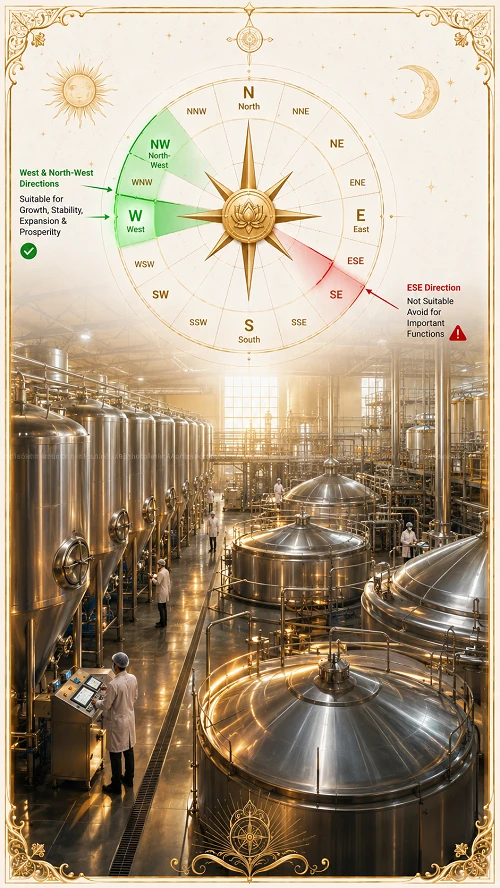
The Optimum Coordinates: Fermentation tanks, liquid aging vats, and large fluid mixing systems should sit in the West (Varuna) zone for stable chemical properties, or the North-West (Vayu) zone to encourage a smooth, timely transition from raw ingredients to finished product.
The Structural Violations: Placing bulk fermentation or sensitive liquid mixing tanks in the East-South-East (ESE) zone of anxiety and overthinking triggers erratic chemical balances, unpredictable pH fluctuations, and high batch rejection rates due to unexpected spoiling.
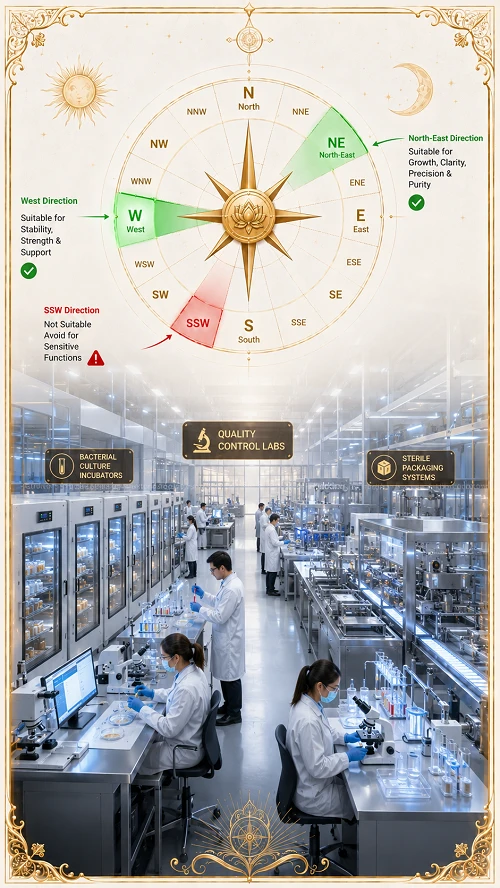
The cleanrooms, microbial testing labs, and sterile packaging lines protect your processed goods from outside contaminants.
The Optimum Coordinates: Quality control labs, sterile packaging systems, and bacterial culture incubators must be positioned in the North-East (Ishan) zone for maximum clarity and organic growth control, or the West (Varuna) zone to secure standard-compliant quality verification.
The Structural Violations: Locating your quality control laboratory or sterile packaging line in the South-South-West (SSW) zone of elimination and waste is a critical error. This setup leads to frequent bacterial leaks, false laboratory readings, missed safety hazards, and costly product recalls that can damage your brand’s reputation.
| Processing Asset / Utility | Ideal 16-Zone Location | Processing & Operational Impact |
| Raw Material Wash Yards | North (N) / North-West (NW) | Safely removes surface dirt and grime while keeping raw ingredients fresh and hydrated. |
| Main Processing Inbound Gate | North (N) / East (E) | Attracts premium corporate supply contracts and steady business opportunities. |
| Chemical & Ingredient Stores | South-West (SW) | Stabilizes delicate raw compounds, preventing early breakdown or spoilage. |
| CIP (Clean-In-Place) Systems | South-South-West (SSW) | Uses the natural elimination zone to thoroughly flush away chemical residues and waste water. |
| Dehydration & Drying Ovens | Standard South-East (SE) | Ensures uniform drying cycles without scorching or burning the materials. |
| Finished Bottling & Packing | North-West (NW) | Speeds up the final packaging and shipping process, preventing inventory bottlenecks. |
In the high-precision processing sector, breaking down stainless-steel piping networks, moving heavy distillation towers, or re-routing embedded utility lines is completely impossible due to strict safety codes, manufacturing down-times, and immense financial costs. At AstroVastuNaksh, we utilize high-precision No-Demolition Micro-Elemental Engineering to balance your processing facility’s energy while keeping your production lines active:
Resonance Grid Balancing: We install mathematically calibrated metal strips (such as Copper, Brass, or Stainless Steel) along structural grid floors and around heavy foundation beds to isolate and neutralize misplaced machine weights.
Color-Wave Pipeline Tuning: We use precise color bands and elemental jacket coatings on product pipelines, storage vats, and reactor walls to balance conflicting directional energies safely.
Virtual Drainage Isolation: We cut and insert specialized metallic energy barriers directly into the floor around misplaced clean-in-place (CIP) drains or chemical effluent lines to virtually isolate and block the spread of negative structural energy.
Stop letting an uncalibrated plant layout cause unexpected batch spoilage, delay your production cycles, and hurt your processing margins. Your facility should be a high-precision engine that operates flawlessly, protects your products, and ensures absolute quality and compliance automatically.
Whether you are designing a new multi-acre food and beverage plant, auditing an underperforming chemical processing unit, or looking to eliminate batch contamination, we are here to help you succeed. Contact AstroVastuNaksh today to book a comprehensive, degree-accurate 16-zone processing Vastu analysis, and align your industrial facility for absolute operational success.
..who are transforming their lives with our weekly update, Subscribe to our Newsletter today!
Check the South East (SE) and South of South East (SSE). Processing units rely on high-load motors, boilers, or heavy automated machinery. If these high-energy assets are crammed into the North (Water Zone), you’re creating a massive “Thermal Shock” in the grid. You’ll suffer perpetual mechanical faults, burnt-out drives, and endless repair bills.
Look at the North East (NE) and West of South West (WSW). NE governs Clarity and Precision, while WSW handles Knowledge and Technical Skills. If your testing lab or QC desk is located in the SSW (Disposal), your technicians will miss obvious defects, or worse, reject perfectly good batches—costing you millions in unnecessary rework.
If your yield-to-scrap ratio is a total disaster, inspect the South of South West (SSW) and East of South East (ESE). Storing raw inputs or conducting primary conversion steps in SSW turns your inventory into waste before it even hits the main line. Shift raw material holding to the South West (SW) for stability and minimal loss.
Finished inventory belongs strictly in the North West (NW) zone. NW is the zone of Movement, Support, and Liquidity. Storing final goods in the NW ensures they don’t sit accumulating dust in the warehouse—they move out to distributors quickly, keeping your working capital cycle tight.
Check the South (S) and South West (SW) zones. The South provides Energy and Stamina, while SW gives Skill Precision. If the main assembly line or labor floor sits in the West of North West (WNW)—the zone of Depression and Detox—your workforce will be chronically fatigued, unmotivated, and prone to costly operational errors.
An ETP or waste treatment facility is fundamentally a Disposal mechanism. It belongs in the SSW (Disposal) or WNW (Detox) zones. If you accidentally build your treatment plant or slurry pits in the North East (NE) or North (N), you are literally dumping toxic waste into your facility’s “Brain” and “Opportunity” centers.
Your heavy power intake, transformers, and HT panels belong in the South East (SE)—the Agni (Fire) quadrant. If your main electrical panel room is placed in the North West (NW) or North East (NE), expect endless regulatory hurdles, delayed power grid syncs, and frequent trippings during peak production runs.
Top 10 Critical Vastu Checks For Home The “Dream Home” or a Structural Trap? The Technical Audit of a Lifetime Buying a property is not

7 Horses Painting In Vastu Why Your “Lucky” 7 Horses Painting Might Be Stalling Your Progress In the cluttered world of “Social Media Vastu,” the

Vastu Tips For Toilets In Home Is Your Toilet Flushing Your Wealth and Health Down the Drain? Let’s stop being polite: Your toilet is the

10 Best Vastu Tips For Mandir In Home: Is Your Mandir Radiating Energy or Absorbing It? If you treat your home temple as just another

10 Best Vastu Tips For Kitchen Is Your Kitchen Cooking Your Finances or Your Health? Welcome to the “Agni” pit of your home—the kitchen. While
© All Rights Reserved - www.AstroVastuNaksh.com
All ‘ * ‘ marked fields are mandatory.
Please ensure the form is filled properly, including all mandatory fields.

Please share your details and our team will connect with you regarding your request.