

Important Vastu Checks for New Home
Top 10 Critical Vastu Checks For Home The “Dream Home” or a Structural Trap? The Technical Audit of a Lifetime Buying a property is not
In heavy manufacturing, chemical processing, automotive assembly, and massive industrial production, selecting raw land is the single most critical factor in determining your manufacturing velocity engine. Industrial land is not just a spatial footprint for factories and warehouses; it is a massive thermodynamic and mechanical grid. It is an environment explicitly engineered to handle immense weight loads, process intense thermal and electrical energy, maintain non-stop assembly line output, and ensure zero equipment downtime.
The catastrophic, margin-destroying error made by industrial entrepreneurs, corporate boards, and plant engineers is acquiring industrial land based solely on per-acre pricing, proximity to rail corridors, or local environmental effluent permits. If your primary manufacturing floor features missing energy vectors, a topography that places heavy blast furnaces in a water gate, or an entrance that triggers constant labor strikes and supply-chain delays, your factory will struggle. You face frequent machinery breakdowns, critical safety accidents, raw material waste, union disputes, regulatory penalties, and frozen production capital.
To build an industrial powerhouse that achieves absolute manufacturing efficiency and stays highly profitable, your raw land selection must be evaluated using a highly sophisticated, degree-accurate 16-zone industrial matrix calibration.
An industrial plot must balance massive mechanical vibrations, high thermal outputs, and heavy inbound logistical weight under a single operational layout.
                      [Industrial Land Energetic Grid]
                                     │
       ┌─────────────────────────────┼─────────────────────────────┐
       ▼                             ▼                             ▼
[The Kinetic Fire Sector]      [The Heavy Mass Anchor]       [The Logistical Conduit]
 ∙ Boiler Units & Power Plants  ∙ Heavy Stamping & Machinery  ∙ Raw Material Storage
 ∙ High-Heat Thermal Zones      ∙ Structural Base Stability   ∙ Inbound & Outbound Docks
 ∙ South-East Agni Dominance    ∙ South-West Grounding Zone   ∙ North & North-West Flow
The areas dedicated to power substations, boiler plants, melting furnaces, and heavy electrical distribution represent the pure fire element (Agni). This zone requires absolute directional alignment to keep thermal energy stable, prevent unexpected industrial fires, and ensure a non-stop power supply to the assembly lines.
The sections of the land where heavy stamping presses, massive CNC machines, and structural steel foundries are built represent the earth element (Prithvi). This area requires the highest level of structural stability to absorb continuous mechanical vibrations without causing structural shifts in the factory floor.
The tracks, access roads, and loading docks where raw materials arrive and finished goods depart represent the air (Vayu) and water (Jal) elements. This zone requires an open, systematic layout to ensure that inventory moves quickly from storage to the factory floor without facing bottlenecks.
Simply click on the button below, fill the attached details to get a detailed personalised e-horoscope with charts, predictions, and suggestions for absolutely FREE!
The selection, soil testing, and energetic layout of industrial production centers (Karmashalas and Dhatu Shalas) are extensively detailed in ancient Sanskrit engineering and architectural texts. Kautilya’s Arthashastra (Book 2, Chapter 12) explicitly commands the state to align manufacturing lands according to cosmic vectors to secure maximum national output:
“The workshops of metallurgists, the minting houses of the state, and the manufacturing centers of weapons must be built upon unshakeable, high-density land sectors that support the fire element. When the furnaces face the true vector of the fire god, the metals melt flawlessly, production speed doubles, workers remain safe, and the state’s industrial power remains unchallenged.”
Furthermore, the Mayamatam details exact methods for testing soil resistance against high heat and heavy weight, proving that industrial zoning is a rigorous mechanical science.
To ensure your raw industrial land is naturally wired for high production output, minimal wastage, and excellent operational safety, its physical layout must pass three critical diagnostic tests.
The location where your factory handles its highest thermal energy dictates the safety, efficiency, and breakdown rate of your plant.
The Optimum Coordinates: Ensure the plot has ample, unobstructed space in the South-East (Agni) or South-South-East (SSE) zone to house your primary boiler plants, casting furnaces, and electrical substations. This fire-dominant alignment optimizes fuel efficiency, keeps machinery running smoothly, and prevents unexpected electrical fires.
The Structural Violations: Purchasing an industrial plot where the only available space for high-heat furnaces or boilers falls in the North-East (Ishan) or North zone creates a major elemental conflict (Fire in the Water gate). This layout leads to constant machinery failures, cracked boilers, poor product quality, and frequent plant shutdowns.
The way weight is distributed across the plot controls the physical safety of your infrastructure and protects the health of your workforce.
The Optimum Coordinates: The plot must naturally have its highest elevation and heaviest structural capacity in the South-West (Nairutya) and South zones. This is the ideal area to install heavy stamping presses, massive storage silos, and secondary manufacturing lines, as it provides an unshakeable foundation that prevents structural shifting.
The Structural Violations: If the plot slopes downward toward the South-West or has hollow ground formations in this sector, installing heavy machinery there will trigger ongoing mechanical errors, high maintenance costs, and severe workplace injuries.
The position of the main commercial vehicle gates dictates how fast raw components arrive and how smoothly finished products reach the market.
The Optimum Coordinates: The primary entrance gates for heavy raw material transport vehicles should be positioned in the North-West (Vayu) or North zones. The wind element helps clear out inventory quickly, which accelerates your manufacturing turnover and cuts down on warehousing costs.
The Structural Violations: Placing your primary raw material intake gate in the South-South-West (SSW) zone of elimination can cause severe logistical delays, constant vehicle breakdowns at the gate, missing supply shipments, and unexpected material losses.
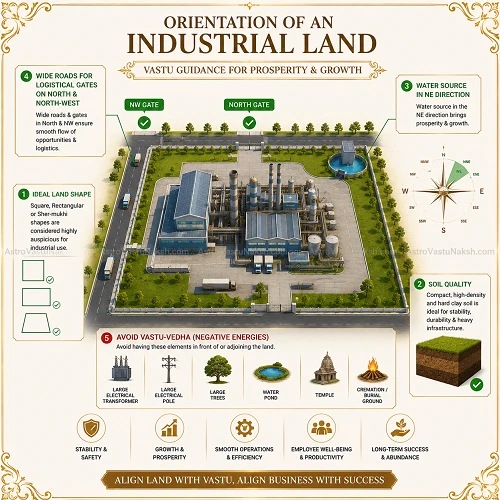
| Industrial Land Variable | Ideal Vastu Specification | Manufacturing & Profit Impact |
| Primary Plot Shape | Perfect Square or Rectangular (up to 1:2) | Keeps all 16 directional zones stable, preventing manufacturing blind spots. |
| Topographical Slopes | Ground slopes down toward North/East | Encourages smooth administrative cash flows and steady new orders. |
| Soil Load Capacity | Compact, high-density rock or hard clay | Securely supports heavy industrial building foundations without sinking. |
| Water Source Access | Deep tube-wells or water storage in the NE | Ensures a reliable water supply for industrial cooling and processing lines. |
| Main Logistical Access | Wide access roads on the North or North-West | Prevents material transport delays and ensures smooth shipping schedules. |
| Historical Land Use | Free from chemical contamination or past failures | Guarantees a fresh, high-vibrational start for your manufacturing plant. |
To keep your industrial workforce alert and minimize factory floor accidents, the color palette for your property boundaries and main gates must be strategically calculated across its 16-zone layout. The main vehicle gates and security barriers should be finished in high-visibility, industrial-grade colors like steel silver, clean titanium white, or sharp safety yellow accents to maintain a structured, professional environment. For the main perimeter boundary walls, use deep cream, warm sand, or rich terracotta tones along the southern and western blocks to ground the land’s energy and anchor your heavy industrial assets. Keep the northern and northeastern boundary walls exceptionally light, using soft off-white or light grey trim to allow positive opportunities to enter the property freely. Avoid painting large factory walls or boundary lines in deep charcoal, solid black, or dark navy blue, as these heavy colors can cause low worker morale, reduce visibility, and lead to careless operational mistakes on the floor.
In multi-acre industrial complexes, attempting to relocate heavy concrete machine foundations, move high-voltage power lines, or change municipal road layouts is financially impossible and causes massive production disruptions. At AstroVastuNaksh, we utilize high-precision No-Demolition Micro-Elemental Engineering to balance your industrial land’s energy while keeping your manufacturing lines running at full speed:
Geo-Magnetic Vibration Balancing: We bury heavy, mathematically calibrated elemental metal blocks (such as thick Lead for South-West stability or pure Copper for South-East fire control) deep into the earth along factory floor lines to absorb and correct misplaced structural weight loads.
Virtual Perimeter Segmentation: We insert specialized metal bars (such as Zinc or Stainless Steel wires) along precise geometric vectors to correct irregular plot shapes, virtually cutting away bad angles or negative extensions without shrinking your actual property boundaries.
Logistical Energy Redirectors: We place custom-designed geometric energy reflectors and metallic helixes at crucial corner points where incoming transport roads meet your land to safely deflect harsh energy waves, ensuring a smooth, safe flow of materials through your gates.
Stop letting an uncalibrated land layout cause machine breakdowns, delay your shipments, and eat into your industrial profits. Your land should be a high-performance manufacturing engine that keeps your operations safe, cuts down on material waste, and drives non-stop production velocity year after year.
Whether you are acquiring a multi-acre plot for a new factory, auditing an underperforming manufacturing plant, or looking to streamline the workflow of an industrial warehouse, we are here to help you succeed. Contact AstroVastuNaksh today to book a comprehensive, degree-accurate 16-zone industrial land Vastu analysis, and align your manufacturing investments for absolute operational success.
..who are transforming their lives with our weekly update, Subscribe to our Newsletter today!
Yes—if you know how to map the Grid Steps (Padas). The fear around South-facing plots is beginner nonsense. If your main heavy transport gate lands in S3 or S4 (Vithatha/Grihakshat), it brings immense operational vigor, rapid output, and strong market presence. But if your gate accidentally sits in SSW (Disposal), your machinery and working capital will go straight down the drain. Precision degrees matter, not broad directions.
Industrial operations demand a tight, uninterrupted 16-zone energy flow. If your plot has an awkward “cut” or extension in the South West (SW), your operational stability and safety record will collapse. A cut in the North West (NW) means your raw material logistics and distributor networks will constantly break down. We use Virtual Partitioning with buried Lead or Brass strips to “square off” the field before you pour the foundation.
You’ve just put toxic industrial waste directly into the plot’s “Spiritual and Mental Center.” An ETP, chemical slurry pit, or heavy drainage pit belongs strictly in the SSW (Disposal) or WNW (Detox) zones. Putting it in the North East (NE) or North (N) triggers severe government compliance penalties, environmental lawsuits, and unexplainable production halts.
Absolutely. Soil Memory (Space History) is very real. Soil that is contaminated, chemically dead, or excavated creates a heavy Tamasic field. If your factory draws its foundational energy from traumatized soil, you’ll face high labor absenteeism, frequent accidents, and poor machine performance. Perform a soil energy audit and treat the ground with High-Frequency Mineral Salts before laying steel.
Industrial land must be higher, heavier, and solidly elevated in the South West, with a gentle slope downward toward the North or East. If your plot tilts downward toward the SW, your profits, liquid cash, and production yields will literally drain away. Elevate the SW ground level during site grading to trap your working capital inside the boundary.

Plastic Household Items Manufacturer, Okhla, Delhi.
Sales conversions improved within one quarter after aligning workspace as per Mr. Naksh advice.
Imitation Jewellery Manufacturer, Rajkot, Gujarat
“Mere liye toh aap bhagwan ban ke aaye thhe, meri doobi hui factory ko bacha liya apne.”
Dental Surgeon (BDS), Shyamnagar, West Bengal
Patients inflow has drastically improved after implementing suggested corrections by Mr. Naksh.
Cloud Kitchen Owner, Newtown, Kolkata.
Peace at home improved drastically after simple Vastu correction suggested by Naksh Sir. Really thankful.
Top 10 Critical Vastu Checks For Home The “Dream Home” or a Structural Trap? The Technical Audit of a Lifetime Buying a property is not

7 Horses Painting In Vastu Why Your “Lucky” 7 Horses Painting Might Be Stalling Your Progress In the cluttered world of “Social Media Vastu,” the

Vastu Tips For Toilets In Home Is Your Toilet Flushing Your Wealth and Health Down the Drain? Let’s stop being polite: Your toilet is the

10 Best Vastu Tips For Mandir In Home: Is Your Mandir Radiating Energy or Absorbing It? If you treat your home temple as just another

10 Best Vastu Tips For Kitchen Is Your Kitchen Cooking Your Finances or Your Health? Welcome to the “Agni” pit of your home—the kitchen. While
© All Rights Reserved - www.AstroVastuNaksh.com
All ‘ * ‘ marked fields are mandatory.
Please ensure the form is filled properly, including all mandatory fields.

Please share your details and our team will connect with you regarding your request.